Best open comb
safety razors.
The best open comb safety razors, explained. Five considered picks, clear tradeoffs, and a closer look at what makes a comb work for you.
A research-backed buying guide. How we chose

This page contains affiliate links. We may earn a commission when you buy through them. As an Amazon Associate, we earn from qualifying purchases. Disclosure
A different razor for a different routine.
The Parker 26C is our starting point for a first open comb. Move toward the R41 for its experienced-shaver focus, the Merkur for low weight, the Fatip for a short grip, or the Variant for adjustment.
A fixed head and substantial handle, without the R41’s expert-only positioning.
Experienced shaversMühle R41The specialist choice for a direct shave and practiced technique.
A lighter, longer gripMerkur 25CThe lightest razor here, with the longest listed overall length.
A compact brass razorFatip PiccoloA short handle and brass construction in the Original open-comb version.
Adjustable settingsParker Variant OCOne razor with a 1–5 dial, for people who want to tune the setup.
The differences, side by side.
Start with the dimensions and design. These are useful comparisons, not a ranking of shave quality.
| Razor | Best reason to choose it | Weight | Length | Construction | Materials |
|---|---|---|---|---|---|
| Parker 26C | A first open comb | 96.4 g | 95.3 mm | Three-piece, fixed | Graphite-plated brass handle |
| Mühle R41 | Experienced shavers | 69.7 g | 92 mm | Three-piece, fixed | Chrome-plated metal |
| Merkur 25C | A lighter, longer grip | 57 g | 104 mm | Three-piece, fixed | Brass handle and comb; zinc cap; chrome finish |
| Fatip Piccolo | A compact brass razor | 70 g | 80 mm | Three-piece, fixed | Nickel-finished brass |
| Parker Variant OC | Adjustable settings | 115 g | 101.6 mm | Two-piece, adjustable | Electroplated brass frame |
Specifications checked September 26, 2026. Published figures and rounded unit conversions; these are not measurements from our own testing. Sources and model notes appear with each recommendation.
How much heft?
How much reach?
Five razors worth considering.

Parker 26C
A first open combThe 26C is our starting point for someone who already understands a double-edge razor and wants to try an open comb. Parker’s linked retailer describes a less aggressive approach than the R41’s manufacturer positioning. That is useful context, not a guarantee of comfort on your face.
Its fixed, three-piece design keeps the choice straightforward: there is no adjustment dial to learn. The graphite-finished brass handle also gives it more mass than the Merkur 25C.
The tradeoff. Choose the Merkur if you want a lighter razor. The 26C’s weight is a reason to keep your grip relaxed, not a reason to press harder.
- Consider it for
- An existing safety-razor user trying an open comb.
- Look elsewhere for
- Someone who strongly prefers a light tool.
3.4 oz and 3¾ in, converted to approximately 96.4 g and 95.3 mm. Source: Parker’s linked retail shop.

Mühle R41
Experienced shaversChoose the standard R41 if you already have reliable control of angle and pressure and deliberately want a direct shave. Mühle explicitly positions this model for experienced wet shavers and denser growth. We would not make it the default first double-edge razor.
The appeal is its specific head design, not a high weight or a long handle. At 69.7 g and 92 mm, it is lighter and shorter than the Parker 26C.
The tradeoff. An efficient-feeling razor can tempt you to chase every last patch of stubble. Stop before repeated cleanup turns a close shave into an uncomfortable one.
- Consider it for
- A practiced shaver who wants Mühle’s direct open-comb geometry.
- Look elsewhere for
- A first-time safety-razor buyer or someone still learning light pressure.
Standard chrome R41. Grande, Twist, and stainless versions have different specifications. Source: Mühle.

Merkur 25C
A lighter, longer gripThe 25C makes sense when handle length matters more to you than heft. Its manufacturer lists a 57 g product weight and 104 mm overall length: the lightest and longest of these five models. That combination is a more concrete reason to choose it than an unmeasured “aggression score.”
You can hold farther down the handle without taking on the mass of the Variant. Its three-piece construction also comes apart for cleaning.
The tradeoff. A long handle will not automatically give you better control, and a light razor still cuts with minimal added pressure. If you like a short grip close to the head, compare the Piccolo instead.
- Consider it for
- A shaver who wants low weight and extra handle reach.
- Look elsewhere for
- Someone looking for a notably heavy or compact razor.
57 g is Merkur’s stated product weight, not its packaging weight. Source: Merkur.

Fatip Piccolo Original
A compact brass razorThe Piccolo is the compact option. Fatip lists the Nickel Original at 80 mm overall, with brass construction and a 70 g weight. It is close to the standard R41 in mass but noticeably shorter on paper.
A short handle suits someone who prefers to guide the razor near its head. The material is another clear distinction: Fatip specifies brass throughout, rather than simply describing a metal finish.
The tradeoff. Check the full model name. Original is the open comb discussed here; Gentle and slant versions are different products. Do not buy on the word “Piccolo” alone.
- Consider it for
- A shaver who values a compact grip and brass construction.
- Look elsewhere for
- Someone who wants a long handle or adjustable settings.
Measurements refer to the Nickel Original. Archive image shows a Piccolo; exact finish is not verified. Source: Fatip.
Parker Variant Open Comb
Adjustable settingsThe Variant OC adds a setting dial to the open-comb format. Parker specifies settings from 1 to 5, with 1 the mildest, and a two-piece construction. It is the option to consider if you want adjustment instead of buying several fixed heads.
At 115 g it is also the heaviest model here. Its adjustment range gives you a variable to explore, but comparisons are easier if you keep the same blade and change only one setting at a time.
The tradeoff. More choice adds complexity. Start at the low end and follow Parker’s operating instructions; the numbers are settings on this razor, not a standardized scale you can compare with another brand.
- Consider it for
- Someone who wants adjustable settings and likes a heavy razor.
- Look elsewhere for
- A buyer who wants the simplest or lightest setup.
Graphite open-comb version. Length is 4 in, converted to 101.6 mm; use Parker’s stated 115 g product weight. Source: Parker.
What does the open comb actually do?
An open-comb guard has separate teeth with spaces between them. A closed comb has a continuous safety bar. Those spaces leave a route for lather and stubble rather than placing an uninterrupted bar ahead of the blade.
The teeth do not make a razor automatically aggressive. The head also controls blade position. Gap is the space between the blade and guard; exposure describes how far the edge sits relative to the line joining the cap and guard. Cap shape and shaving angle matter, too.
There is no standardized “aggression out of ten” scale behind this guide. Choose the whole razor, not just the comb label.

More open space is a design choice.
It can be useful when lather and stubble build up, especially with several days of growth. But the comb alone cannot promise fewer passes, less irritation, or a closer finish. Blade, preparation, pressure, and your own growth pattern still matter.
Compare that with the R41’s explicitly direct positioning and the 26C’s more moderate manufacturer-linked description: both are open combs, yet they are intended to offer different experiences.
How to choose your open comb
Start with what you want to change about your current shave. If the answer is “less tugging,” check your blade and preparation before replacing the entire razor. If it is “my razor fills up with lather and several days of growth,” an open comb is worth considering. If your current setup gives you comfortable results, an open comb is an alternative to explore, not a necessary upgrade.
Match the design to your experience
A first open comb and a first safety razor are different purchases. Someone moving from a closed-comb double-edge razor already has a reference for blade loading, angle, and pressure. Someone moving from cartridges is learning all three. Our Parker 26C recommendation is aimed at the former. The R41 belongs on the shortlist only when a direct shave is something you actively want.
If you are still learning, start with the basics in our shaving and razor guides. A well-practiced routine matters more than owning the most demanding head design.
Choose a grip before chasing a specification
Think about where your fingers naturally sit on your current razor. A short handle can be comfortable if you work close to the head. A longer one gives you more places to grip, but can feel unwieldy around the chin. The measurements above are overall lengths, not exposed handle lengths; they help narrow a shortlist rather than prove a particular grip will fit.
Weight is also a preference. The 57 g Merkur and 115 g Variant bookend this list, but neither number predicts a closer shave. If you are happy with the weight of your current razor, use it as your reference. Do not assume heavier means better built or that a light razor needs extra downward pressure.
Fixed or adjustable?
A fixed head removes a decision from the morning. An adjustable razor adds room to experiment. The Variant’s dial can be useful if you want to explore different settings, but it also makes it easier to change too many things at once. Keep your blade, lather, and routine consistent while learning a new setting. The goal is a repeatable comfortable result, not the highest number on the dial.
Look at the full ownership cost
The purchase price is only one part of the decision. Check shipping, returns, replacement-part availability, and the exact model supplied. Compare a complete razor with a complete razor; head-only listings and bundles can make prices misleading. All five use double-edge blades, so you are not committing to a proprietary cartridge system. Start with a small blade selection before buying in bulk.
A more deliberate first shave
A new razor deserves a slow first outing. The American Academy of Dermatology’s shaving guidance supports wetting hair, applying shaving cream, following the grain, and rinsing the blade. Use the blade and lather you already know, and give yourself time to notice what has changed.
- Map the direction first. Let a little stubble grow, then feel which direction is smooth and which offers resistance. Your neck may change direction several times. Save those directions in the shaving grain mapper.
- Soften the stubble and apply lather. Work with comfortably wet hair and a lubricated surface. If lather dries while you are taking your time, refresh it before continuing.
- Begin with a light grip and short strokes. Find a working angle gently. Do not force the comb into your skin or assume every razor needs the same handle angle.
- Make the first pass with the grain. Follow the direction you mapped, rather than automatically shaving down everywhere. Rinse the head frequently.
- Re-lather before another pass. If your skin feels comfortable, reassess whether another pass is worthwhile. A perfectly smooth result is not worth repeated scraping over a sore spot.
- Stop and adjust one thing next time. If the shave feels harsh, do not add pressure. Return to a familiar blade or razor and reassess your preparation and technique.
An open comb is not a treatment for razor bumps, ingrown hairs, or irritation. Do not shave over damaged skin simply because a product is marketed as efficient.
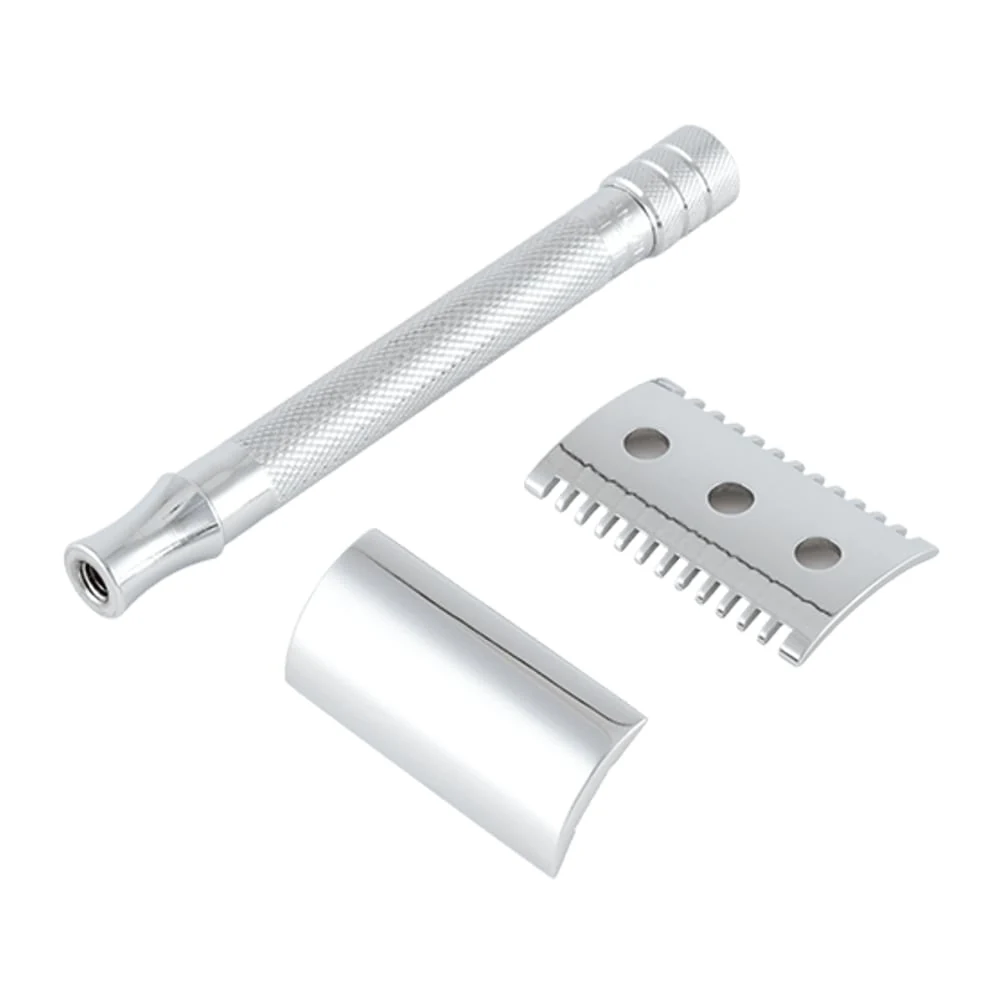
Loading and looking after the razor
Work over a stable surface. Hold a blade by its short, unsharpened ends, align it as the maker instructs, and tighten the razor securely without forcing the threads. Check that the assembled head is even before shaving. The Variant is a different, two-piece mechanism, so follow its own loading and adjustment instructions.
After use, rinse away lather and hair and allow the razor to dry. Use a soft brush for buildup rather than scraping plated surfaces with metal. Follow the manufacturer’s care advice for the finish. Put used blades in a suitable blade bank or sharps container; check local disposal instructions before emptying it.
Questions before you buy
Is an open comb always more aggressive than a closed comb?
No. The teeth describe the guard shape. Blade gap, exposure, cap geometry, blade choice, and technique also affect how a razor behaves. Avoid treating “open comb” as a measured aggression rating.
Which one would you choose for a beginner?
For someone already comfortable with a double-edge razor, the Parker 26C is our first open-comb shortlist choice. For a complete beginner, we would prioritize learning technique with a forgiving setup rather than starting with the R41. These are editorial recommendations, not comparative test results.
Can I use one every day?
Potentially, if that particular razor and your technique suit your skin and growth. Daily use is not a reason by itself to choose an open comb. If you feel sore after shaving, give your skin a break and reconsider the setup rather than treating discomfort as something to push through.
Will it shave a full beard?
An open comb can leave more space for lather and stubble, but it is still a razor. Trim a long beard down first. Trying to run a safety razor through full-length beard hair is a different task from shaving a few days of stubble.
What is the difference between the R41 and R89?
The R41 is Mühle’s open-comb model; the R89 uses a closed comb. They are different head designs, not interchangeable names for the same razor. This guide’s R41 specifications apply to the standard chrome version, not the Grande or Twist.
Which blade should I buy?
There is no blade that makes every head feel the same. If you already use a double-edge razor, try your familiar blade first so the razor is the main variable. Otherwise, start with a small selection and note comfort, tugging, and how the edge feels over successive shaves. Do not buy a large pack based only on someone else’s favorite.
What happened to the previous picks?
Earlier editions included the West Coast Shaving 175BL and Plisson Joris. They are no longer active recommendations in this guide because we have not established sufficiently clear current model specifications and purchase options for this comparison. That is an evidence gap, not a finding that either razor performs poorly. The five-model shortlist above gives each recommendation a specific reason to be here.
How we put this guide together
This edition is a research-backed buying guide, not a new hands-on test. We checked manufacturer specifications and the retailer linked by Parker, then selected five distinct use cases: a first open comb, an experienced-shaver option, a light long-handled razor, a compact brass razor, and an adjustable model. We do not assign star ratings or invent laboratory scores.
The photographs come from the Tools of Men archive. They help show construction and form, but do not demonstrate current testing, identical scale, or every available finish. Measurements are published specifications, not our own measurements. Inch and ounce conversions are rounded; differences of a fraction of a millimeter or gram are not meaningful buying advantages.
Product links use exact model destinations from our archive or the manufacturer’s linked store. Some links earn a commission. Price, seller, stock, finish, and included blades can change; check the retailer’s current listing before ordering.
Specification sources
- Parker 26C — Parker’s linked retail shop
- Mühle R41 — Mühle
- Merkur 25C — Merkur
- Fatip Piccolo Original — Fatip
- Parker Variant Open Comb — Parker
Originally published September 5, 2023. Substantially updated September 26, 2026.